
Types of Emergency Lighting Certificate
An emergency lighting certificate is a formal record confirming that the emergency lighting in a building has been designed, installed, inspected and tested in line with BS 5266-1, the British Standard code of practice for emergency lighting. It shows that if the mains power fails, the lighting will switch on and give people enough light to leave the building safely.
For the responsible person in a business, the certificate is the evidence that this part of their fire safety duty is being met. Fire safety officers, insurers and auditors will usually ask to see it, together with the emergency lighting log book, during an inspection or when a claim is made. There are two main certificates under BS 5266-1, and which one a building needs depends on whether the system is new or already in use.
Completion Certificate
A completion certificate is issued when a new emergency lighting system is installed, or when an existing system is extended or significantly altered. It confirms the system has been designed, installed and verified to BS 5266-1, and it is supported by signed declarations covering each of those stages. On larger projects, the design, installation and verification may be signed off by different people, so the completion certificate brings everything together in one place.
Periodic Inspection and Test Certificate
A periodic inspection and test certificate is issued for an existing system once it has been inspected and given its annual full duration test. It confirms the system continues to work as it should and records any deviations from the standard, along with the work needed to put them right.
The Emergency Lighting Log Book
Alongside both certificates sits the emergency lighting log book. BS 5266-1 sets out what the log book should contain, and it is kept on site as the running record of routine tests, faults, repairs and servicing between certificates.
What an Emergency Lighting Certificate Should Include
A properly completed certificate should give a clear picture of the system and its condition, including:
- Details of the premises, the occupier and the person responsible for the system
- The type of system, such as self contained luminaires or a central battery system, and whether fittings are maintained or non maintained
- The areas covered, including escape routes, open areas and high risk task areas
- The results of the inspection and the full duration test
- Any deviations from BS 5266-1 and the remedial work recommended
- Confirmation that the log book is in place and up to date
- The date of the next inspection
A certificate with all of these details in place will stand up well to scrutiny from a fire safety officer or insurer.
How Long Is an Emergency Lighting Certificate Valid?
An emergency lighting certificate is renewed each year. BS 5266-1 recommends a full duration test and periodic inspection every 12 months, so a new periodic inspection and test certificate should be issued after each annual test. Monthly function tests are also needed in between, and these are recorded in the log book rather than on a certificate. You can read more about how each test works in our guide to emergency light testing.
A new completion certificate is needed whenever the system is installed, extended or significantly changed, for example after an office refit that moves partitions or creates new escape routes.
TES Compliance carries out emergency lighting inspection, testing and certification for commercial premises across the UK, so your certificate and log book are always ready when they are needed.
Is Emergency Lighting a Legal Requirement?
Yes. Emergency lighting is a legal requirement for almost all non domestic premises in the UK. Under the Regulatory Reform (Fire Safety) Order 2005, emergency routes and exits that need lighting must have emergency lighting of adequate intensity in case the normal lighting fails.
Who Is Responsible for Emergency Lighting?
The duty sits with the “responsible person”. In a workplace this is the employer, and in other premises it is usually the owner, landlord, managing agent or whoever has control of the building. Where several people share control, such as a landlord and a tenant in a multi let office, each is responsible for the areas they control and they are expected to work together.
The responsible person must make sure the emergency lighting is suitable for the building, kept in good working order and tested regularly, with records to show it.
Which Buildings Need Emergency Lighting?
The requirement applies to most premises used for work or open to the public, including:
- Offices, shops and warehouses
- Hotels, restaurants and pubs
- Schools, care homes and healthcare settings
- Factories and industrial units
- The common areas of blocks of flats and houses in multiple occupation (HMOs)
The fire risk assessment for the building decides exactly where emergency lighting is needed and what type of
system suits the premises best.
Emergency Lighting Regulations in the UK
Several regulations on emergency lighting work together in the UK. The law sets out the duty to provide it, and British Standards explain how to meet that duty in practice.
The Regulatory Reform (Fire Safety) Order 2005
This is the main piece of fire safety law in England and Wales. It requires the responsible person to carry out a fire risk assessment, provide emergency routes and exits, and make sure those routes are lit if the power fails. It also requires fire safety equipment, including emergency lighting, to be maintained in efficient working order.
The Fire Safety (England) Regulations 2022
The Fire Safety (England) Regulations 2022 add further duties for responsible persons in multi occupied residential buildings in England, such as checks on fire doors and sharing fire safety information with residents. Emergency lighting in the common parts of these buildings remains an important part of the fire safety measures they cover.
The Workplace (Health, Safety and Welfare) Regulations 1992
Regulation 8 of these regulations requires suitable emergency lighting in workplaces where people would be put in danger if the normal artificial lighting failed.
Building Regulations Approved Document B
Approved Document B covers fire safety in new buildings and major refurbishments in England. It sets out where escape lighting is needed and points to BS 5266-1 for guidance on design and installation.
Scotland and Northern Ireland
In Scotland, the equivalent duties come from the Fire (Scotland) Act 2005 and the Fire Safety (Scotland) Regulations 2006. In Northern Ireland, they come from the Fire and Rescue Services (Northern Ireland) Order 2006 and the Fire Safety Regulations (Northern Ireland) 2010. The principles are the same: a risk assessment, safe escape routes and emergency lighting that works when it is needed.
What Happens If Emergency Lighting Isn’t Compliant?
Fire and rescue authorities enforce these regulations. They can issue enforcement notices requiring improvements, prohibition notices restricting the use of a building, and in serious cases bring a prosecution, which can lead to an unlimited fine or imprisonment. Insurers may also question a claim if emergency lighting has not been tested and certified, so up to date records protect the business as well as the people in it.
BS 5266 Explained
BS 5266 is the series of emergency lighting British Standards used across the UK, and BS 5266-1 is the code of practice at its centre. The current edition, BS 5266-1:2025, replaced the 2016 version and gives detailed guidance on how emergency lighting should be designed, installed, tested and maintained.
BS 5266 emergency lighting guidance is not law in itself, but it is the recognised benchmark for meeting the legal duties above. Following it is the clearest way for a responsible person to show their emergency lighting is suitable.
The Related British Standards
BS 5266-1 is designed to be read alongside two other standards, both updated in 2024:
- BS EN 1838:2024 sets the minimum light levels needed on escape routes, in open areas and in high risk task areas
- BS EN 50172:2024 covers the installation, verification, testing and maintenance of emergency escape lighting systems
Together, these three standards set out what good emergency lighting looks like from design through to day to day upkeep.
Types of Emergency Lighting
BS 5266-1 recognises several types of emergency lighting, each with a different purpose:
Escape route lighting
helps people find and follow the way out, including stairs, corridors and exit doors
Open area lighting
reduces panic in larger spaces, such as open plan offices, and helps people reach an escape route
High risk task area lighting
gives people enough light to safely shut down dangerous processes or machinery before leaving
Standby lighting
keeps normal activities going during a power cut, although this is not part of the safety requirement
Maintained and Non Maintained Emergency Lighting
A maintained emergency light stays on at all times and keeps working when the power fails. These are common in cinemas, theatres, shops and other spaces where the public may be unfamiliar with the layout.
A non maintained emergency light only switches on when the normal lighting fails. These are the most common choice for offices, warehouses and other workplaces where staff know the building.
BS 5266-1 also sets out how often systems should be tested, with a monthly function test and an annual full duration test. Our guide to emergency light testing explains what each test involves.
Emergency Lighting for Offices
Emergency lighting for offices follows the same rules as any other workplace, but office layouts bring their own challenges. Open plan floors, meeting rooms, kitchens and shared stairwells all need careful planning to make sure everyone can get out safely.
Where Offices Need Emergency Lighting
BS 5266-1 highlights a number of points where emergency lighting should be provided, including:
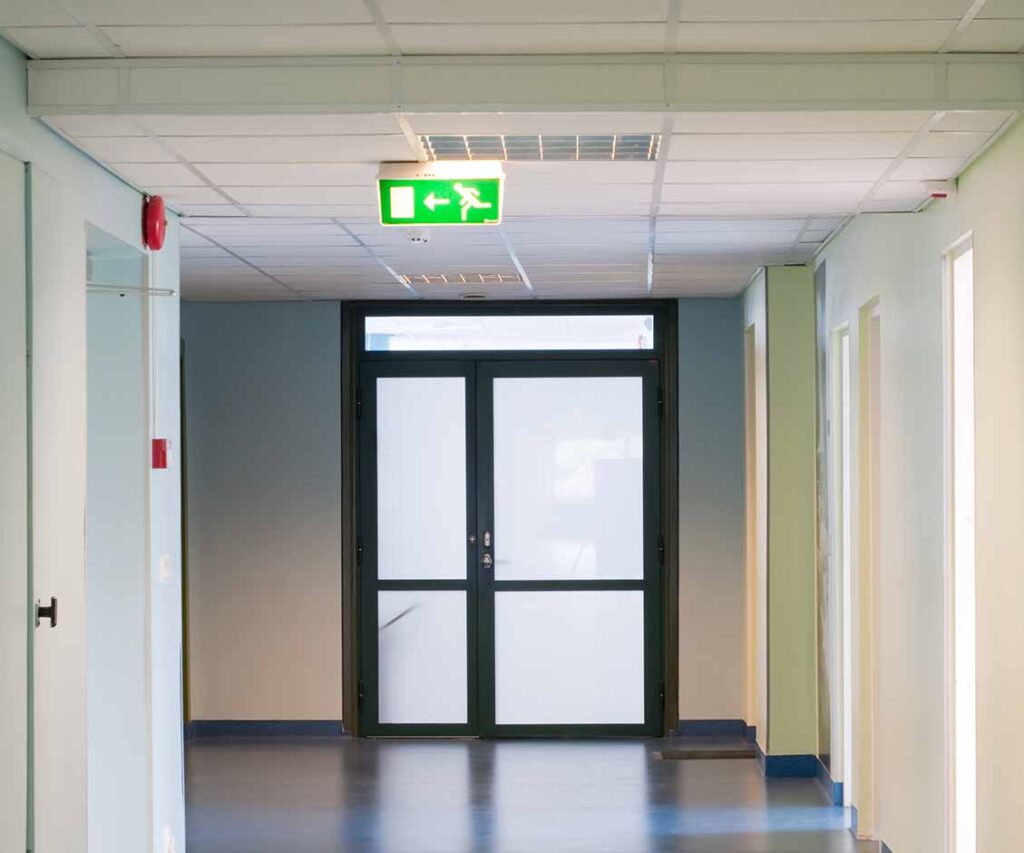
- Near every exit door and emergency exit
- On stairs, so each step gets direct light
- At every change of direction and corridor junction
- Near fire alarm call points and firefighting equipment
- Near first aid points
- In open plan areas, to help people reach an escape route
- In lift cars
- In accessible toilets and larger toilet areas
- In plant rooms, switch rooms and other areas housing essential equipment
Exit signs should also be lit so they stay visible in a power cut, guiding people along the escape route to a final exit.
Common Gaps in Office Emergency Lighting
Many office compliance issues come from changes to the building rather than faults in the fittings. Typical examples include:
- Office refits that add partitions, meeting pods or new walls, leaving areas without coverage
- Change of use, such as turning storage into desk space or adding a kitchen
- New occupants in a multi let building where nobody has checked who is responsible for the shared areas
- Missing log books, so there is no record of monthly testing
Whenever the layout of an office changes, the emergency lighting should be reviewed as part of the fire risk assessment, and a new completion certificate issued if the system is altered.
When to Replace Emergency Lighting Batteries
Batteries are the part of an emergency lighting system that wears out first. Self contained emergency luminaires are designed around a battery life of around four years, in line with the product standard BS EN 60598-2-22, after which the battery may no longer hold enough charge to run the light for its full rated duration.
Signs a Battery Needs Replacing
The clearest sign is a failed annual full duration test. If a fitting cannot stay lit for its full rated duration, the battery needs replacing. Other signs include:
- A charging indicator that is off or showing a fault
- A light that switches on during a test but dims or cuts out early
- Swollen, leaking or discoloured battery packs
- Batteries that are past their design life, even if they still pass a function test
What Affects Battery Life?
Battery life depends on the battery type, the quality of the charging circuit and the conditions the fitting is installed in. Heat is the biggest factor, so fittings in warm areas such as plant rooms, kitchens or ceiling voids above lighting often need batteries replacing sooner. Nickel cadmium, nickel metal hydride and lithium batteries are all used in emergency lighting, and newer lithium iron phosphate batteries generally last longer than older types.
Replacing the Battery or the Whole Fitting
In many cases a like for like battery replacement is all that is needed. If fittings are older, damaged or use fluorescent lamps, replacing the whole unit with modern LED emergency lighting is often the better long term choice. LED fittings use less energy, put less strain on the battery and last far longer. Find out more about our LED lighting conversions or read our guide on how long LED lights last.
Signs Your Emergency Lighting Needs Maintenance
Regular testing should pick up most issues, but there are signs anyone in the building can look out for between visits:
- Indicator lights that are off, flashing or showing a fault colour
- Failed monthly tests, where a fitting does not switch on or stays dim
- Discoloured or damaged diffusers, which reduce the amount of light reaching the floor
- Missing, faded or damaged exit signs
- Fittings blocked by new shelving, partitions, signage or decorations
- Changes to the building layout, such as new rooms or rearranged escape routes
- Gaps in the log book, with missed tests or faults left unrecorded
- Ageing fittings and batteries that are approaching the end of their design life
If you spot any of these, arrange a check as soon as possible. Faults should be recorded in the log book along with the action taken to put them right, so your records stay complete for the next inspection.
How TES Compliance Can Help
TES Compliance provides emergency lighting installation, testing, maintenance and certification for commercial premises across the UK. As an NICEIC approved contractor, our engineers carry out every inspection to BS 5266-1 and give you a clear certificate, an up to date log book and practical recommendations for any remedial work.
We can also look after your wider fire safety needs, including fire alarm systems and fire safety services, so your compliance is managed by one team.
To arrange an emergency lighting inspection or certificate, request a quote and our team will be in touch.