
How Often Should Fire Alarms Be Tested? Weekly, Six-Monthly and Annual Requirements
Under BS 5839-1, the British Standard for fire detection and alarm systems in non-domestic premises, fire alarms should be tested every week by someone on site. A competent person should inspect and service the system at least every six months. Here is how that breaks down:
Weekly
Operate one manual call point to confirm that the control panel receives the signal and the sounders activate. Use a different call point each week.
Monthly
If the system is backed up by a standby generator, start it up and check that it runs correctly.
Every six months
A competent fire alarm engineer inspects and services the whole system, including the control panel, standby batteries, detectors and sounders.
Annually
Every detector and manual call point should be functionally tested at least once a year. This testing is usually spread across the two six-monthly service visits.
These are minimum intervals. Your fire risk assessment may recommend more frequent checks if it finds a higher level of risk, for example in care homes, other buildings where people sleep, or premises with a history of false alarms.
Record every test and service in your fire alarm logbook. The logbook is your record of compliance, and it helps your engineer spot faults that keep coming back.
Fire Alarm Testing Requirements
UK fire alarm testing requirements come from two sources. The law sets out who is responsible for the system, and the British Standard sets out how it should be tested and maintained.
Who Is Responsible for Fire Alarm Testing?
In England and Wales, fire safety in non-domestic premises falls under the Regulatory Reform (Fire Safety) Order 2005. The Order places the duty on the Responsible Person, who is usually the employer, the building owner, or whoever has control of the premises, such as a managing agent or landlord.
Article 17 of the Order requires the Responsible Person to keep fire safety equipment, including fire detection and alarm systems, in efficient working order and good repair. Serious breaches can lead to unlimited fines and, in the most serious cases, imprisonment.
Scotland and Northern Ireland have their own fire safety legislation, but the duty to maintain fire alarm systems in good working order is much the same.
The Role of BS 5839-1
The law does not set out testing intervals itself. BS 5839-1 is the code of practice that fire and rescue authorities, insurers and fire risk assessors use as the benchmark for non-domestic premises. Following it is the clearest way to show that your system is properly maintained.
BS 5839-1 recommends:
- A weekly test of a manual call point, carried out by a nominated person on site
- Inspection and servicing by a competent person at intervals of no more than six months
- Functional testing of every detector and call point at least once a year
- A record of all tests, faults and servicing kept on site
Homes and smaller residential buildings, including many houses in multiple occupation, come under BS 5839-6 instead. That standard has its own testing recommendations.
Keeping a Fire Alarm Logbook
The logbook is your evidence that the system is being looked after. It should record:
- Each weekly test, including the date, time and call point used
- Any faults, along with the action taken to fix them
- False alarms and their likely cause
- Every service visit and any work carried out on the system
Keep the logbook near the control panel so the person testing and your engineer can both get to it. In the event of an inspection, an insurance claim or a fire, it is often the first document you’ll be asked to show.
Who Can Test and Service a Fire Alarm?
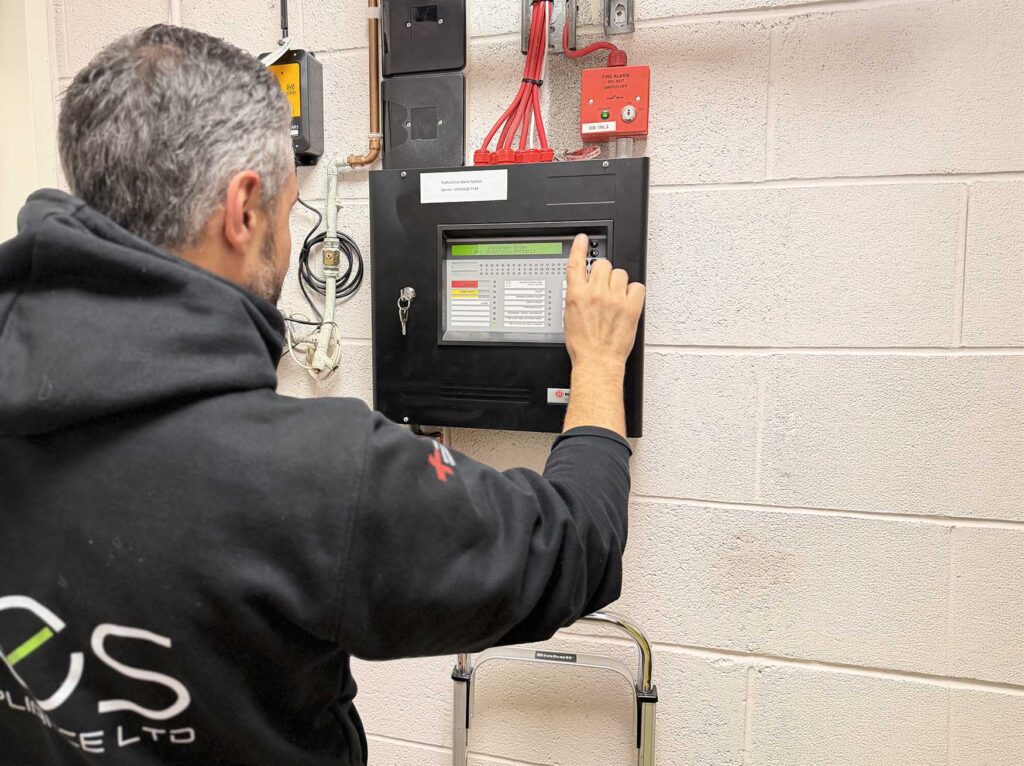
A nominated member of staff can carry out the weekly test once they have been shown how to do it. Six-monthly servicing is a different matter. It must be done by a competent person with the knowledge, training and experience to work on fire detection and alarm systems.
TES Compliance is NICEIC approved, and our engineers inspect, test and service fire alarm systems for businesses across the UK.
Weekly Fire Alarm Testing Explained
The weekly fire alarm test is the simplest check in BS 5839-1 and one of the most important. It confirms that the system can detect a signal, process it at the control panel and raise the alarm across the building. A nominated person on site usually carries it out, using a test key supplied with the system.
How to Carry Out a Weekly Fire Alarm Test
- Let staff and occupants know that a test is about to take place, so nobody mistakes it for a real fire.
- If your system is monitored by an alarm receiving centre, contact them before you start.
- Choose the next manual call point on your rotation and activate it with the test key.
- Check that the control panel shows the correct zone or device.
- Make sure the sounders activate and that the alarm can be heard clearly throughout the building.
- Silence and reset the system at the control panel, then reset the call point.
- If the system is monitored, confirm with the alarm receiving centre that they received the signal, then let them know the test is complete.
- Record the test in the fire alarm logbook, including the date, time and call point used.
Rotating Call Points
Use a different manual call point each week, working through every call point in the building in turn. That way, every call point gets tested regularly, and a fault in any one device or circuit is found quickly. A simple numbered list or plan of call point locations kept with the logbook makes the rotation easy to follow.
Choosing the Right Time for the Test
BS 5839-1 recommends testing at roughly the same time each week, during normal working hours. Building occupants then learn to recognise the weekly alarm as a test, and anyone hearing it at another time knows to treat it as real.
If your staff work shifts, run an occasional extra test at other times so that everyone hears the alarm and knows what it sounds like.
What to Do If the Alarm Does Not Sound
If the panel does not respond, a sounder stays silent, or the alarm cannot be heard in part of the building, the system is not working as it should. You should:
- Record the fault in the logbook straight away
- Contact your fire alarm engineer to arrange a repair
- Review your fire risk assessment and put temporary measures in place until the fault is fixed, such as extra fire marshals or more regular checks of affected areas
- Tell staff about any area where the alarm may not be heard
Don’t wait for the next six-monthly service to deal with a fault. A system that fails its weekly test may not warn people in a real fire.

Fire Alarm Servicing Frequency
BS 5839-1 recommends that fire alarm systems are inspected and serviced by a competent person at intervals of no more than six months. For most commercial premises, that means two service visits a year. Your fire risk assessment may call for more.
What Happens During a Six-Monthly Service
A six-monthly service covers the whole system, not just the parts that are used in the weekly test. Your engineer will typically:
- Review the logbook for faults, false alarms and any issues reported since the last visit
- Check for changes to the building, such as new partitions, changes of use or extensions, that could affect detector coverage or how well the alarm can be heard
- Inspect and test the control panel, including its fault indicators and controls
- Check the standby batteries and charger to make sure the system will keep running if the mains power fails
- Functionally test a share of the detectors and manual call points, so that every device is tested across the year
- Check that sounders and visual alarm devices work and can be heard or seen throughout the building
- Test the link to any alarm receiving centre
- Check that connected systems respond correctly, such as door hold-open devices, plant shutdown or lift controls
- Record the visit in the logbook and issue a servicing certificate
Annual Testing Requirements
BS 5839-1 does not call for a separate annual inspection. Instead, it expects every detector and manual call point to be functionally tested at least once every 12 months. Most engineers spread this work across the two six-monthly visits, so that the whole system has been tested by the end of the year.
Some components, such as standby batteries, also have a limited service life. Your engineer will advise on replacing them in line with the manufacturer’s guidance.
When More Frequent Servicing Makes Sense
Six months is the maximum interval, and some premises benefit from more frequent visits. These include:
- Buildings where people sleep, such as care homes, hotels and student accommodation
- Sites with a history of false alarms, where regular checks help find the cause
- Harsh environments, such as commercial kitchens, warehouses and workshops, where dust, heat or steam can affect detectors
- Larger or more complex systems linked to other building controls
Your fire risk assessment is the best guide to the servicing frequency your premises need.
Fire Alarm Servicing From TES Compliance
TES Compliance provides fire alarm installation, inspection and servicing for businesses across the UK. Our engineers carry out six-monthly servicing in line with BS 5839-1, keep your logbook up to date and give you clear records for your fire risk assessment, insurers and fire authority. Find out more about our fire alarm detection services.
Fire Alarm Testing Checklist
Use this checklist to keep your fire alarm testing on track. Keep a copy with your logbook so the person carrying out the tests and your engineer are working from the same list.
Weekly
- Tell occupants that a test is about to take place
- Contact the alarm receiving centre first, if the system is monitored
- Activate the next manual call point on the rotation using the test key
- Check that the control panel shows the correct zone or device
- Confirm that the sounders activate and can be heard throughout the building
- Silence and reset the panel, then reset the call point
- Confirm with the alarm receiving centre that the signal was received
- Record the date, time and call point used in the logbook
- Report any fault to your fire alarm engineer straight away
Monthly
- Start up and check any standby generator that supports the fire alarm system
- Make sure all manual call points are visible and clear of obstructions
- Check that detectors have not been covered, painted or blocked by stock, furniture or new fittings
- Check that the control panel shows normal operation, with no fault or disablement lights showing
Every six months
- Arrange inspection and servicing by a competent fire alarm engineer
- Make sure the engineer reviews the logbook, including faults and false alarms
- Tell the engineer about any changes to the building or how it is used
- Check that a share of detectors and call points has been functionally tested
- Keep the servicing certificate with your logbook
Annually
- Refresh training for anyone nominated to carry out the weekly test
- Confirm that every detector and manual call point has been tested within the last 12 months
- Review your fire risk assessment and make sure the testing and servicing frequency still suits your premises
- Check whether standby batteries or other components are due for replacement
Frequently Asked Questions
Everything you need to know about our electrical testing and compliance services, including costs, frequency, legal obligations and what to expect from your inspection.
Is weekly fire alarm testing a legal requirement?
The law requires the Responsible Person to keep the fire alarm system in efficient working order. It does not set out testing intervals itself. BS 5839-1 recommends a weekly test, and fire and rescue authorities and insurers expect to see this followed. In practice, weekly testing is the standard way to show that you are meeting your legal duty.
Can I test the fire alarm myself?
Yes, for the weekly test. A nominated member of staff can carry it out once they have been shown how to do it safely and record it correctly. Six-monthly inspection and servicing must be carried out by a competent fire alarm engineer.
Do we receive a certificate after a fire alarm service?
Yes. After each service visit, your engineer should update the logbook and issue a servicing certificate confirming the work carried out and any faults found. Keep it with your logbook as evidence that the system is being maintained.
What are the risks of skipping fire alarm testing?
A fault that goes unnoticed could stop the alarm from warning people in a real fire. Missing tests can also leave the Responsible Person open to enforcement action under the Fire Safety Order, and may affect an insurance claim if records cannot show the system was properly maintained.
How often should fire alarm batteries be replaced?
Standby batteries have a limited service life, which varies by type and manufacturer. Your engineer checks them at every six-monthly service and will advise when they need replacing.