
What Does PAT Testing Mean?
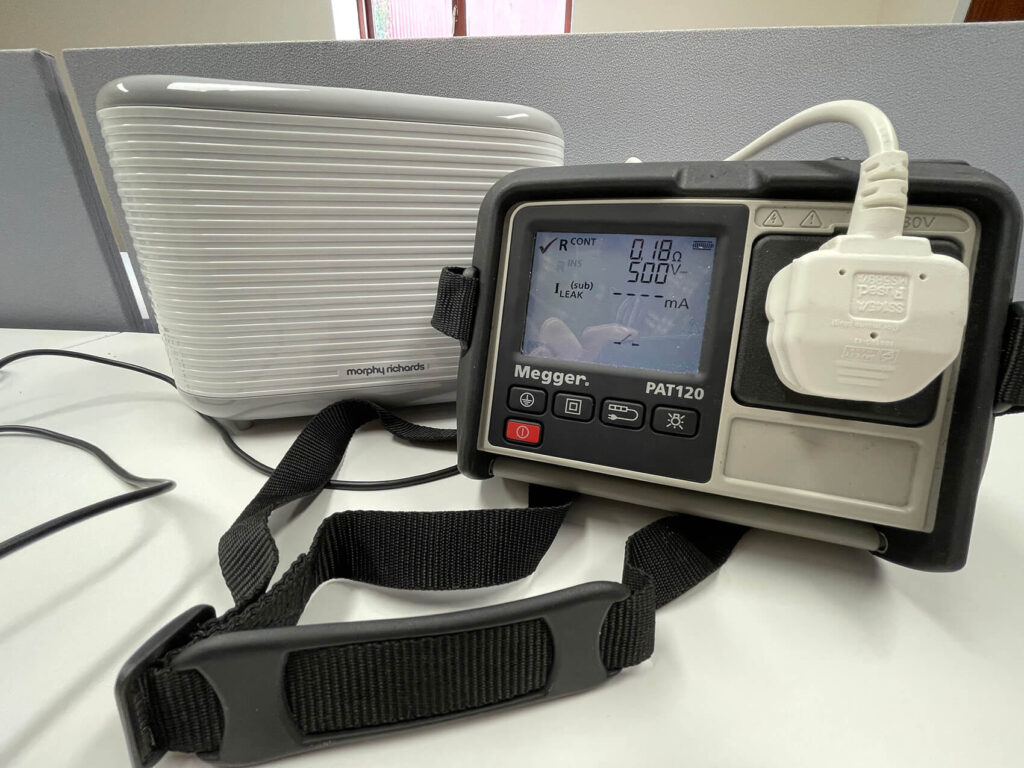
PAT testing stands for Portable Appliance Testing. It’s the process of checking electrical appliances and equipment to make sure they’re safe to use, covering things like visual inspection, earth continuity, insulation resistance and functional checks, depending on the type of appliance.
The word “portable” is a bit misleading. In practice, PAT testing used to apply mainly to anything with a plug, from kettles and laptops to power tools and catering equipment. It now also includes fixed appliances, equipment that isn’t on a plug at all, such as something hardwired directly into the electrics, or a wall heater supplied via a switch rather than a socket. Employers have a legal duty under the Electricity at Work Regulations 1989 to keep electrical equipment in a safe condition, and PAT testing is the standard way of demonstrating that.
PAT testing is now known as EET. You’ll find out why further down this page.
How Often Is a PAT Test Required?
There’s no single legal timescale that applies to every business. PAT testing frequency depends on the type of equipment, how often it’s used, and the environment it’s used in. A power tool on a construction site needs checking far more often than a desk lamp in a quiet office.
As a general guide:
- High-risk environments (construction, industrial, catering) typically need testing every 3 to 6 months
- Offices and low-risk commercial premises usually need testing every 12 to 24 months
- Portable equipment used off-site (extension leads, tools taken between locations) should be checked more frequently than fixed equipment
There’s no fixed rule written into law that sets these intervals. Instead, employers are expected to assess the risk and set a testing schedule that’s appropriate for their equipment and how it’s used. If you’re not sure what frequency applies to your business, that’s exactly what a PAT testing provider like TES Compliance can help you work out during your first inspection
How Long Does a PAT Test Take?
This depends entirely on how many items need testing and the type of equipment involved. A single appliance can typically be tested in a few minutes, while a full office or commercial site with hundreds of items will naturally take longer.
Rather than working to a fixed time estimate, our engineers assess the number and type of appliances on-site and provide a clear timeframe as part of your quote, so you know what to expect before testing begins.
Who Can Carry Out PAT Testing?
PAT testing isn’t a legally regulated qualification in the same way as some other electrical work, but that doesn’t mean anyone can do it competently. A proper PAT test requires a good understanding of electrical safety, the right testing equipment, and the knowledge to interpret the results correctly, particularly for fixed appliances and more complex equipment.
At TES Compliance, all EET testing is carried out by trained, competent engineers who follow current standards and best practice, giving you a certificate you can rely on for compliance and insurance purposes.
Which Sectors Need PAT Testing?
Any business that uses electrical equipment has a duty of care to keep it safe, so PAT testing applies across almost every sector. Some of the most common include:
- Offices – computers, monitors, printers and kitchen appliances all need regular checks as part of office PAT testing
- Retail and hospitality – catering equipment, till systems and customer-facing electricals carry higher usage and risk
- Construction and industrial sites – power tools and portable equipment used in demanding conditions need more frequent testing
- Healthcare and education – settings with high footfall and vulnerable users, where equipment safety is closely scrutinised
- Landlords and letting agents – appliances provided in rented properties fall under the same duty of care

Commercial and Office PAT Testing
Offices and commercial premises are some of the most common places we carry out PAT testing, covering everyday items like computers, monitors, printers, kettles and other kitchen appliances. Even where usage feels low risk, regular testing helps meet the legal duty under the Electricity at Work Regulations 1989 and gives staff, visitors and insurers confidence that equipment is safe.
We work with offices and commercial premises across the UK, including London, Southampton and Crawley, tailoring testing schedules to the size of the site and how the equipment is used.
Why Is PAT Testing Now Called EET?
The name PAT testing is being replaced by EET, which stands for Electrical Equipment Testing. This isn’t a rebrand by TES Compliance, it reflects a wider change across the electrical industry. The change was prompted by the Institution of Engineering and Technology, which was concerned that the term “portable appliance testing” was misleading, since all mains powered electrical equipment should be tested, not just portable appliances.
The updated terminology appears in the 5th Edition of the IET Code of Practice for In-Service Inspection and Testing of Electrical Equipment, which sets the standards followed across the industry. The name EET better reflects the true scope of the work, covering both portable appliances and certain fixed electrical equipment, rather than portable items alone. The checks, standards and certification you receive stay the same, only the terminology has changed.
At TES Compliance, we’ve adopted the EET name in line with this update, so you may see the service referred to as PAT, EET, or both, depending on the context.
Many clients pair this with an EICR as part of a wider compliance check.
Class 1 and 2 PAT Testing
PAT testing covers two main appliance classes, and the checks involved differ between them.
- Class 1 appliances have basic insulation and rely on an earth connection for safety, think kettles, toasters and most metal-bodied equipment. These require an earth continuity test as part of the inspection.
- Class 2 appliances are double insulated and don’t rely on an earth connection, common examples include laptop chargers and some power tools. These don’t need an earth continuity test, but still require insulation and functional checks.
Knowing which class an appliance falls into affects how it’s tested and how often. Read our full guide to Class 1 and Class 2 PAT testing for a closer look at the differences.
PAT Testing With TES Compliance
PAT testing, now known as EET, plays a key part in keeping your equipment safe and your business compliant. Regular PAT testing helps you meet your legal duty and avoid unnecessary risk, whether you’re managing a single office or a multi-site operation.
If you’re due a test or want to know which parts of your building fall under EET testing, our engineers can talk you through what’s needed. Many clients also carry out an EICR alongside their PAT testing, as part of a wider electrical testing programme.