
If you’ve had an electrical inspection recently, you might have heard the term “distribution board” come up, often shortened to a DB board or DB box on site. It’s one of the most important pieces of equipment in any commercial or industrial electrical installation, yet it’s rarely given much thought until something goes wrong.
What Is a Distribution Board?
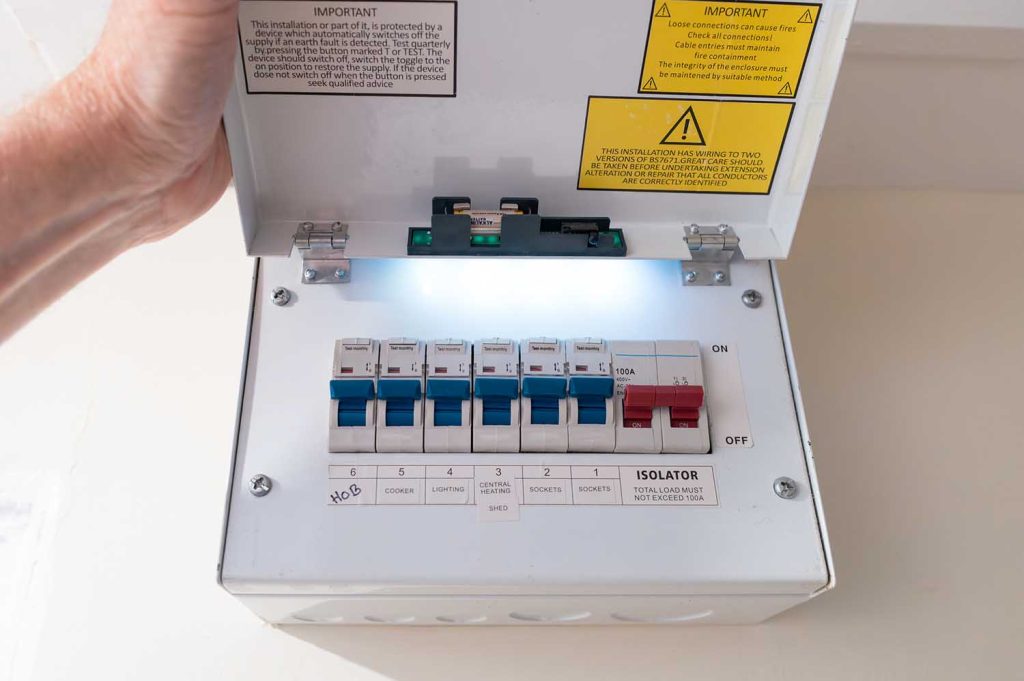
A distribution board is the point in an electrical installation where the incoming power supply is split into separate circuits, each protected by its own circuit breaker or fuse. Think of it as the control centre of a building’s electrical system: every lighting circuit, socket circuit, and piece of fixed equipment is fed and protected from here.
Inside a typical distribution board you’ll find:
- An incoming main switch or isolator
- Miniature circuit breakers (MCBs) or residual current breakers with overload protection (RCBOs) for each individual circuit
- Busbars that carry current to each protective device
- In larger installations, meters, contactors, or timers for specific circuits
On a construction site or in trade conversation, you’ll often hear a distribution board called a DB board or DB box. These are simply informal names for the same piece of equipment. Larger buildings typically have a main distribution board feeding the incoming supply, with several sub-distribution boards positioned around the building to serve different floors, departments, or areas.
Distribution Board vs Consumer Unit: What’s the Difference?
This is one of the most common questions we’re asked, and the two terms are often used interchangeably even though they’re not quite the same thing.
A consumer unit is the term used specifically for the protective device board in a domestic property, a single dwelling with a single-phase supply. A distribution board is the broader term, generally used in commercial and industrial settings, and can refer to boards fed by either a single-phase or three-phase supply.
The practical differences tend to come down to scale and construction. Distribution boards in commercial and industrial buildings are typically larger, built to handle higher loads, and are more likely to be part of a wider network of boards rather than a single unit serving the whole building. They’re also more likely to require three-phase distribution to run larger machinery, HVAC plant, or high-capacity equipment.
What Is a TPN Distribution Board?
TPN stands for triple pole and neutral, sometimes written as three phase and neutral. A TPN distribution board is designed to accept a three-phase electrical supply and distribute it across circuits that may be single-phase, three-phase, or a mix of both.
You’ll typically find TPN boards in commercial and industrial premises where the electrical load is too high for a standard single-phase supply, such as buildings with large motors, industrial machinery, commercial kitchens, or extensive HVAC systems. Each way on a TPN board can usually be configured to take a single-pole breaker for a single-phase circuit or a triple-pole breaker for a three-phase circuit, which gives a lot of flexibility when designing circuits for mixed-use buildings.

Signs a Distribution Board Needs Replacing
Distribution boards don’t tend to fail without warning. There are usually signs building up beforehand, and knowing what to look for can help you act before a fault causes downtime or a safety issue. Common signs include:
Age and outdated components.
Older boards fitted with rewireable fuses or lacking RCD protection no longer meet current safety expectations. If your board predates modern wiring regulations, it’s worth having it assessed.
A non-metallic or combustible enclosure.
Amendment 3 to BS 7671 introduced a requirement for consumer units and similar switchgear in domestic premises to be housed in a non-combustible enclosure, typically metal, following a series of fires linked to plastic consumer unit enclosures. The IET’s guidance on the enclosure requirement sets out the background in full. While this specific regulation applies to domestic consumer units, the same fire safety principle is a strong factor when assessing older commercial and industrial boards too.
Warmth, discolouration, or scorch marks.
Any sign of heat damage around a distribution board, including discoloured plastic, a burning smell, or visible scorching, points to a fault that needs urgent attention. This is exactly the kind of issue a thermal imaging survey is designed to catch before it becomes visible to the naked eye.
Frequent tripping or nuisance faults.
If breakers are tripping repeatedly without an obvious cause, it can indicate the board itself is struggling rather than a fault on an individual circuit.
Insufficient capacity.
As buildings grow, add equipment, or change use, the original distribution board may no longer have the capacity or the spare ways to support the current electrical load safely.
Corrosion or physical damage.
Boards installed in damp plant rooms, outbuildings, or exposed locations can suffer corrosion to busbars and terminals over time, increasing the risk of a poor connection and localised overheating.
Adverse findings on an EICR.
An Electrical Installation Condition Report will flag issues with a distribution board using observation codes. A C1 code means there’s a danger present and immediate action is required, while a C2 code means the issue is potentially dangerous and urgent remedial work is recommended. Either code against the distribution board itself is a strong signal that replacement, not repair, is the right route.